People For Success
  • Sign In
  • Create Account

  • Bookings
  • My Account
  • Signed in as:

  • filler@godaddy.com


  • Bookings
  • My Account
  • Sign out

  • Home
  • Leadership Training
  • Respect@Work Training
  • Cultural Alignment
  • People Skills Training
  • Coaching Programs
  • Leadership Tools
  • About Us
  • Contact Us
  • Leadership BLOG
  • Events
  • Testimonials
  • Leadership in Action
  • Leadership Resources
  • The Ethics Penalty
  • More
    • Home
    • Leadership Training
    • Respect@Work Training
    • Cultural Alignment
    • People Skills Training
    • Coaching Programs
    • Leadership Tools
    • About Us
    • Contact Us
    • Leadership BLOG
    • Events
    • Testimonials
    • Leadership in Action
    • Leadership Resources
    • The Ethics Penalty
People For Success

Signed in as:

filler@godaddy.com

  • Home
  • Leadership Training
  • Respect@Work Training
  • Cultural Alignment
  • People Skills Training
  • Coaching Programs
  • Leadership Tools
  • About Us
  • Contact Us
  • Leadership BLOG
  • Events
  • Testimonials
  • Leadership in Action
  • Leadership Resources
  • The Ethics Penalty

Account


  • Bookings
  • My Account
  • Sign out


  • Sign In
  • Bookings
  • My Account

The Ethics Penalty

Why ethical leadership does not always become recognised leadership authority.

Find out more

Developed by Kristyn Haywood through a Master of Research scholarship at Macquarie Business School. The Ethics Penalty explains how gendered evaluation can shape whether ethical judgement is recognised as leadership competence and authority.

The Ethics Penalty Academic Figure

The Ethics Penalty Explained

The Ethics Penalty

Why ethical leadership does not always become recognised leadership authority

The Ethics Penalty explains how ethical judgement can be recognised and valued, yet not strengthen a person’s standing as a leader. Over time, these differences in how leadership is interpreted can flow through performance reviews, talent discussions, promotion decisions and other

Relational Leadership

Why ethical leadership does not always become recognised leadership authority

The Ethics Penalty explains how ethical judgement can be recognised and valued, yet not strengthen a person’s standing as a leader. Over time, these differences in how leadership is interpreted can flow through performance reviews, talent discussions, promotion decisions and other connected evaluation systems.

Relational Leadership

How ethical leadership is expressed through relationships

Relational Leadership includes fairness, honesty, care, respect, trust, responsiveness and responsibility for the impact of decisions on others.

These behaviours are central to ethical leadership. But when they are expected of women, they may be appreciated without being recognised as evidence of leadership competence or authority.

Ethical Authority

When ethical leadership requires courage, challenge and accountability

Ethical Authority is visible when leaders speak up, set boundaries, confront misconduct, hold others accountable, refuse unethical action and exercise ethical judgement in difficult or contested situations.

These behaviours can strengthen leadership authority. But for women, exercising authority can also make that authority more likely to be questioned or contested.

The Competence Gate

How ethical judgement becomes, or fails to become, leadership authority

When ethical judgement becomes visible, it is interpreted through what I call 

The Competence Gate. 

The question is whether that judgement is recognised as evidence of leadership competence, legitimate authority and decision-making weight.

This evaluation is not gender-neutral. Gendered expectations can shape whose judgement is more readily granted weight and whose authority is more readily questioned.

The Moral Double Bind

Two different ways ethical leadership can fail to strengthen women’s authority

When a woman shows care, fairness and collaboration, those behaviours may be valued but treated as expected rather than as evidence of leadership capability.

When she challenges, sets boundaries or holds others accountable, her authority may become more contestable.


This patterned asymmetry is The Moral Double Bind.

Making Leadership Talent Visible

The organisational cost is not only unfair evaluation. It is missed talent.

The Ethics Penalty can operate through ordinary evaluation systems that appear neutral. Small differences in how behaviour is described and interpreted can accumulate across performance, talent and promotion decisions.

Organisations may already have the ethical leadership talent they are looking for. Their evaluation systems may simply not be recognising it.


The Ethics Penalty framework was developed by Kristyn Haywood through Master of Research scholarship at Macquarie Business School.

The Ethics Penalty Practical Handout

Download PDF

Academic Conferences

The Ethics Penalty: 

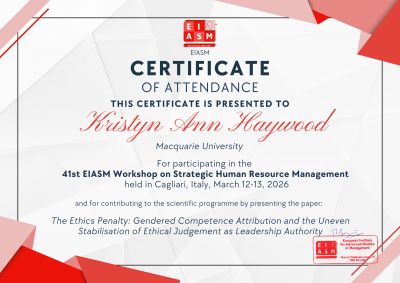
EIASM 2026 | Cagliari, Italy

EIASM 2026 | Cagliari, Italy

41st Workshop on Strategic Human Resource Management

The Ethics Penalty: Gendered Competence Attribution and the Uneven Stabilisation of Ethical Judgement as Leadership Authority

Presented at the European Institute for Advanced Studies in Management Strategic Human Resource Management Workshop.

This paper positioned organisational evaluation systems as the place where leadership authority is produced and reinforced. It introduced The Competence Gate as the mechanism through which ethical judgement may become recognised leadership authority, remain valued conduct without leadership standing, or become legitimacy-contestable authority. 

It also connected these repeated evaluative patterns to recruitment, performance appraisal, high-potential identification and succession, showing how apparently ordinary HR systems can contribute to durable differences in whose ethical judgement acquires leadership standing. 


The central proposition:
Ethical judgement does not inherently become leadership authority. Organisations help determine whether it does.
SASE 2026 | Bordeaux, France

SASE 2026 | Bordeaux, France

Business, Conflict and Peacebuilding

The Ethics Penalty as a Governance Vulnerability

Presented at the 2026 Society for the Advancement of Socio-Economics Conference, Sciences Po and University of Bordeaux.


This paper extended The Ethics Penalty into the Business and Peace field, examining what happens when organisations fail to select and authorise ethical leaders. It argued that when ethical authority is not recognised, organisations can lose the people most likely to surface risk, challenge misconduct, protect dignity, resist corruption and prevent harm. 


The central proposition:
Peace is more possible when organisations select and authorise ethical leaders.


Powered by

This website uses cookies.

We use cookies to analyze website traffic and optimize your website experience. By accepting our use of cookies, your data will be aggregated with all other user data.

Accept